Takeaways From Our April 2026 Conservation Finance Roundtable
In Brief
The 15th annual Conservation Finance Roundtable was held at Duke University’s Nicholas School of the Environment in Durham, North Carolina, bringing together land conservation practitioners, state agency staff, private investors, farm and forestland owners, and academic researchers to discuss conservation funding opportunities and challenges in North Carolina, the Southeastern US, and beyond.
A key area of focus was private investment in nature-based solutions across the full capital continuum, from catalytic philanthropy to institutional forestland investment. Sessions also dove into financing regenerative agriculture, peatland restoration, the evolving carbon markets landscape, and the role of aggregators in scaling conservation outcomes.
We learned about two examples of how conservation finance can help connect communities to land and capital: the Lumbee Tribe’s land return project in southeastern North Carolina and the McIntosh S.E.E.D. Community Forest in coastal Georgia.
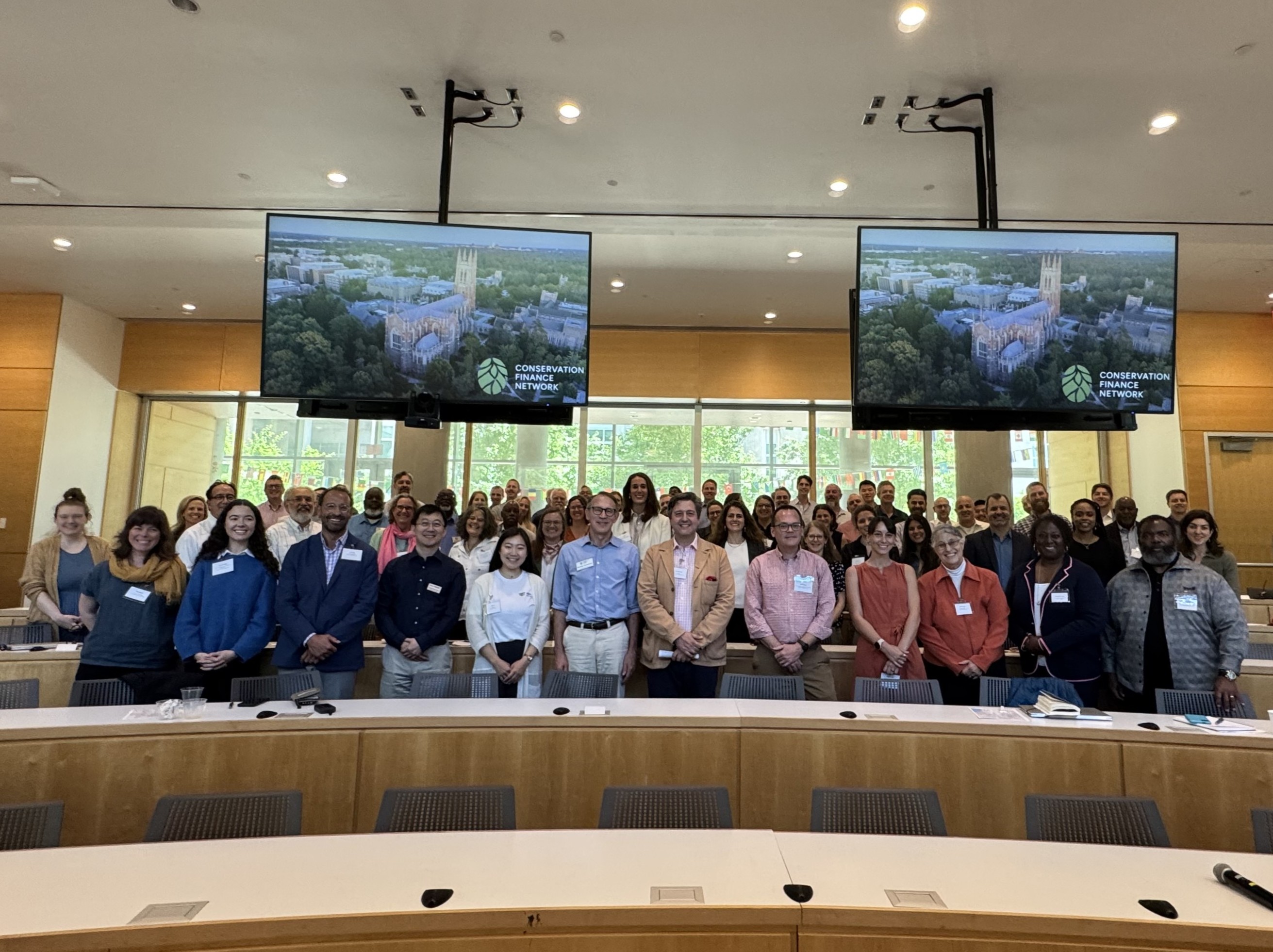
On April 23-24, 2026, the Conservation Finance Network convened our 15th annual Conservation Finance Roundtable at the Nicholas School of the Environment at Duke University. Attendees from across the country gathered to participate in two days of sessions on themes ranging from private forestland investment and regenerative agriculture to community-based conservation and the latest developments in carbon markets. This article summarizes topics discussed; the full event agenda is available here.
Jacque Demko, the Director of the Stewarding Native Lands Initiative at First Nations Development Institute, delivered the keynote address, centering the conversation on Indigenous sovereignty in conservation finance. First Nations Development Institute, founded in 1980, has distributed more than $111 million to Native American projects and organizations. Jacque described the organization’s Woven Lands Initiative, which is creating new models, investments, and financing tools to secure and expand Native ownership and stewardship of Tribal homelands. She shared examples from several grantees including the Blackfeet Nation’s tribal biocultural diversity crediting framework, the Chugach Regional Resources Commission’s eDNA-based biodiversity verification work, the Wabanaki Commission’s salt marsh carbon and data sovereignty project, the Molokai Heritage Trust’s effort to permanently restore Native Hawaiian stewardship of the 55,000-acre Molokai Ranch, the Indigenous Conservation Council’s land rematriation fund, and the Wind River Tribal Buffalo Initiative. Jacque closed by inviting the roundtable attendees to consider how conservation metrics can better capture the social, cultural, and intergenerational benefits of stewardship, how decision-making authority can shift to communities, and how capital criteria can evolve as federal support for conservation fluctuates.
We had two Innovation Round-Up sessions, which touched on exciting conservation finance innovations and projects around the region and beyond. Innovations included:
George Dusenbury of the Trust for Public Land described the Georgia Outdoor Stewardship Act (GOSA), which since its initial passage in 2019 has dedicated a portion of existing sales taxes to allocate $142 million in funding for 74 conservation and park projects. With GOSA set to expire in 2028, Dusenbury shared an update on recent efforts to build a bipartisan coalition to advocate for continued GOSA funding.
Sara Clow of Mad Agriculture introduced the Wilding Pilot. Mad Agriculture’s initiative aims to support 65 million acres of biodiverse ecological corridors woven through working agricultural, energy, and transportation landscapes across North America. The effort is beginning with a 1,000-acre pilot in the Southern Driftless region of Wisconsin with Amazon, Whole Foods, and 20 other food and beverage companies as corporate partners.
Nate Truitt of the American Forest Foundation offered an assessment of the carbon market landscape, noting a sharp bifurcation in the voluntary carbon market between a large inventory of low-quality legacy credits and a growing pool of high-quality credits commanding significant price premiums. He argued that the field’s most important task is demonstrating that nature-based solutions can provide permanent carbon storage, a challenge he believes is solvable through endowment-style governance structures.
Andrew Crosson of Invest Appalachia described the organization’s https://investappalachia.org/work to match external capital to community priorities to drive conservation and economic opportunities. He described how areas of economic distress in central Appalachia overlap with biodiversity hotspots. Invest Appalachia is an intermediary that uses a creative capital stacking approach to combine social capital, grants, catalytic capital, investment capital, and credit enhancements to finance their work to create a prosperous, equitable, and resilient Appalachian region.
Joanna Fischer-Whilden of the Trust for Public Land presented Appalachia United Outdoors, a five-year, $10 million initiative funded by the Appalachian Regional Commission. The project deploys multiple strategies to advance outdoor recreation-based conservation and economic development strategies across eight Appalachian states.
Joshua Humphreys of the Croatan Institute reported out from the Soil Wealth Capital Convening held the day before the Roundtable. The convening focused on Croatan’s North Carolina Soil Wealth Areas framework, regional financing districts designed to coordinate capital and technical assistance for resilient food, fiber, and forestry systems. Humphreys also described the launch of a second cohort of Croatan’s Soil Wealth Areas Cohort and described the new Resilient Southern LAND Fund, which seeks to raise $25 million over five years to acquire and transition farmland into regenerative management.
Sara Mason of the Duke Nicholas Institute for Energy, Environment, and Economy described two new resources: a Nature Finance Case Study Library with 17 documented examples of nature-based solutions projects that have successfully used different financing mechanisms and a research project inventorying 67 nature-based solutions incubator and accelerator programs operating nationally and globally.
Peter Howell of the Conservation Finance Network moderated a session on trends in impact investing with Morgan Snyder of the Walton Family Foundation, Trevor Cutsinger of the U.S. Endowment for Forestry and Communities, and JP Gibbons of Cambridge Associates. The discussion explored the role of catalytic capital in activating private financing for nature-based solutions, including how the Walton Family Foundation is using impact-first investments as a bridge between philanthropic and institutional sources of capital, how the U.S. Endowment is investing in early-stage companies building markets for wood and forest products, and how Cambridge Associates is advising endowments and foundations seeking market-rate returns from impact investments in environmental markets.
Professor Richard Bin Mei of Duke University moderated a panel on private investment in forestland with Weiyi Zhang of Manulife, Cakey Worthington of Aurora, and Peter Stein of Lyme Timber. The panelists described the evolving landscape of institutional timberland ownership that is diversifying income streams through carbon credits, recreational leasing, mitigation banking, and vertical integration into sawmills and logging operations. They discussed the growing importance of sustainability reporting to a wide range of investors from Wall Street advisors to climate-oriented family offices.
A session on utilizing finance to incentivize the implementation of regenerative land management practices brought together Maggie Monast of the Environmental Defense Fund, Sarah Zoubek of the Foundation for Food and Agriculture Research (FFAR), and Scott Marlow of Long Rows Consulting. Maggie described EDF’s collaboration with FFAR, Cornell University, and the Walton Family Foundation to build the research track record agricultural lenders and insurers need to create new products that are better aligned with the risk-reduction and long-term profitability benefits of regenerative practices. Sarah described FFAR’s role in crowding in private research funding to address precompetitive challenges that no single company can solve alone. Scott delivered a historical framing of federal agricultural policy, illustrating how the programs governing crop insurance, disaster payments, and credit have been designed to drive concentration and industrialization. This panel left us with a question: as AI and new data tools rapidly reveal the financial value of regenerative practices, who will capture that value, and how do we ensure it flows to farmers?
Tripp Wall of Pantheon Regeneration presented a deep dive into peatlands restoration, describing a 14,500-acre project in North Carolina that is re-wetting degraded peatlands through water control structures and gravity-fed freshwater systems. By ceasing emissions of degraded peatlands and restarting the cycle of peat accumulation, the project generates measurable, durable carbon removal. Pantheon pairs 40 years of Duke-based peat restoration research with proprietary ecological intelligence software to support what Tripp described as a "polysolution,” simultaneously sequestering carbon, mitigating fire risk, and restoring hydrology and biodiversity.
Margaret Bowman moderated a session on the role of aggregators in a conversation with Lauren Alleman of Ducks Unlimited, Nate Truitt of American Forest Foundation, and Jason Lee of Blue Forest. The panelists explored both the opportunity and the challenge of aggregating small landowners and small transactions into projects large enough to access private capital markets. The American Forest Foundation’s Family Forest Carbon Program has enrolled over 1,400 landowners and 194,500 acres since 2020. Lauren described Ducks Unlimited’s Flyway Forests Program that uses permanent agreements with farmers to protect and restore grassland and wetland habitats. Jason described how conservation organizations are often held back by inefficient funding and financing architecture, rendering them unable to function without grants and forced into opportunistic rather than strategic project selection. Blue Forest seeks to make available upfront financing for forest restoration through tools like their Forest Resilience Bond.
A session on landscape scale conservation in South Carolina featured Maria Whitehead of the Open Space Institute, Ben Duncan, South Carolina’s Chief Resilience Officer, and David Jones of the South Carolina Forestry Commission. The panelists described South Carolina’s commitment to conservation that draws on roughly $250 million in state funding and $170 million from federal programs to support projects which advance the forest products industry, while reducing flood risk and improving climate resilience. David Jones described how Georgia’s forestry industry supports more than 100,000 jobs, and thus conservation projects are seen as helping protect the forest products industry.
Roy Richards, Jr. of Terrah Conservation Capital and Green South Foundation delivered closing reflections on the first day, describing the role of fast, flexible bridge capital in enabling large-scale land conservation across the Southeast. Terrah provides short-term loans to land trusts to allow them to move quickly when high-priority properties come to market, solving a fundamental timing challenge in conservation transactions. To date, Terrah Conservation Capital has experienced zero losses across roughly 47 transactions and deployed more than $120 million.
Day two opened with a session on private and philanthropic investment in farmland, moderated by Katie Michels of the Conservation Finance Network, with Ian McSweeney of Farmers Land Trust, Dominick Grant of Dirt Capital, Wood Turner of Agriculture Capital, and Weiyi Zhang of Manulife. The panel explored how different sources of capital shape outcomes on the ground. From Farmers Land Trust’s commons-based ownership model and Dirt Capital’s lease-to-purchase structure for regenerative farmers, to Agriculture Capital’s vertically integrated supply chain approach and Manulife’s institutional farmland portfolio, all approach the same issue with different strategies. A recurring theme was the tension between land appreciation as a driver of investment returns and land affordability as a prerequisite for farmer ownership and intergenerational wealth.
A panel on partnerships in community-based conservation featured two case studies. Larry Edwards of the Lumbee Tribe described the tribe’s effort to reclaim and steward land in their traditional territory in southeastern North Carolina. This project centers conservation as well as culture, medicine, food access, youth education, and tribal sovereignty. This land return project, supported by partners including the Open Space Institute and Ducks Unlimited, illustrated how conservation finance can be structured to support cultural reconnection alongside ecological stewardship. Cheryl Peterson and John Littles of McIntosh S.E.E.D. described the acquisition and management of a 1,148-acre community forest in coastal Georgia that supports sustainable forestry and landowner and youth education for a Black-led organization that initially struggled to access traditional sources of funding or financing for land acquisition. Together, the projects highlighted the need for conservation finance tools that are accessible and reparative for communities that have stewarded land for generations.
The Conservation Finance Network would like to thank all of the attendees of our 15th Conservation Finance Roundtable. We extend a special thanks to our host, the Duke Nicholas School of the Environment, and the graduate students at Duke who volunteered to support the event. The discussions in Durham reflect conversations we look forward to continuing to track, including the maturation of carbon markets, promising strategies to fund Indigenous land return, creative deployment of catalytic philanthropic capital, and the use of aggregation and intermediary structures to leverage private investment in sustainable land management, among other topics.